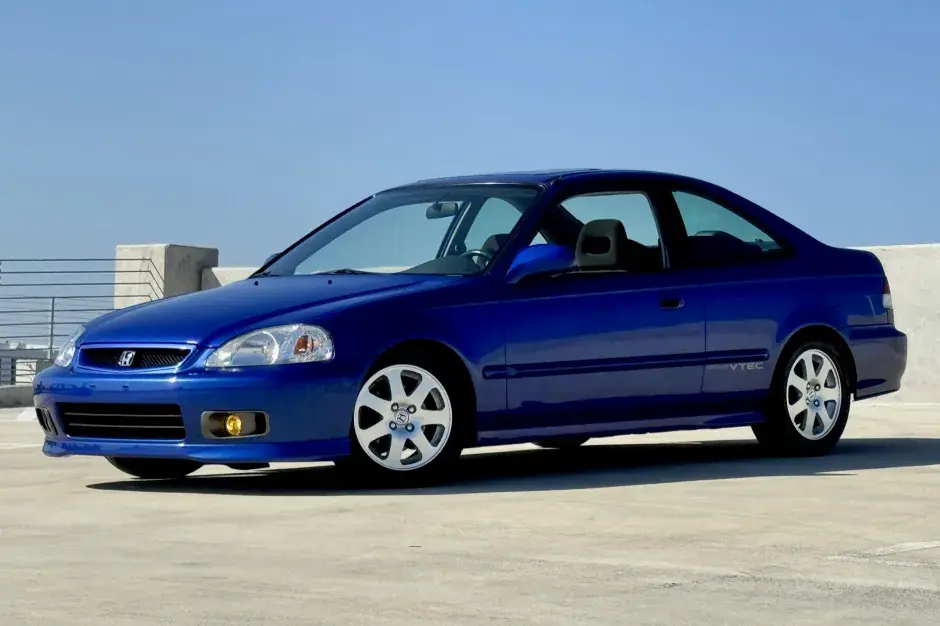
There was a time when the 2000 Honda Civic Si was one of the most desirable platforms in the import performance scene.
The EM1 came from an era when Honda enthusiasts were experimenting with Jackson Racing superchargers, Vortech setups, Greddy turbo kits, B16 builds, and lightweight street cars that could embarrass cars with twice the displacement.
Fast-forward to today, and the EM1 is still an incredible platform — but the technology available to build one has changed dramatically.
If we were building a 2000 Civic Si today, we'd take everything that made the EM1 great and combine it with modern turbocharging, engine management, suspension, and drivetrain technology.
The Classic B16A2
The heart of the 2000 Civic Si was the B16A2 VTEC engine.
With its high-revving nature, lightweight design, and excellent aftermarket support, the B16 became one of Honda's most iconic four-cylinder engines.
Back in the day, enthusiasts commonly looked toward superchargers from Jackson Racing or Vortech, while turbo enthusiasts turned to companies such as Greddy and other early Honda tuning brands.
Those setups helped establish the reputation that Honda performance cars still have today.
But if you're building an EM1 in 2026, there are more powerful options.
The Modern Answer: K-Series
For an all-out modern build, one of the most attractive combinations is a K24/K20 setup with a turbocharger.
The K-series gives the lightweight EM1 significantly more displacement and torque while offering enormous aftermarket support.
A properly built K-series turbo setup can produce serious power without requiring the extreme engine combinations that were necessary decades ago.
For a street-oriented build, we'd be looking toward approximately 350–400 wheel horsepower.
And remember — the EM1 is a small, lightweight car.
That amount of power can turn the Civic into a very serious performance machine.
What Could It Run in the Quarter Mile?
Quarter-mile performance will depend heavily on weight, transmission, gearing, tires, suspension, launch technique, and track conditions.
A rough benchmark for a properly sorted EM1 might look something like this:
| Power | Potential 1/4-Mile |
|---|---|
| 300 whp | 12.5–13.0 seconds |
| 350 whp | 11.8–12.4 seconds |
| 400 whp | 11.3–11.8 seconds |
| 450 whp | 10.8–11.4 seconds |
These are not guarantees. A front-wheel-drive Civic has to put the power down.
That's where the build gets interesting.
Traction Is Everything
Making horsepower isn't necessarily the hardest part of building a fast EM1.
Putting that horsepower to the pavement is.
Once you get into the 350–400 whp range, the car needs a drivetrain and chassis capable of handling the additional power.
That means:
- Limited-slip differential
- Proper performance tires
- Correct suspension setup
- Strong axles
- Appropriate transmission
- Proper alignment
- Quality brakes
- Good engine and transmission mounts
- Professional ECU calibration
A 350-whp Civic that launches properly can be more impressive than a 500-whp car that spins through first and second gear.
The Sweet Spot: 350–400 WHP
For a street-driven EM1, we'd argue that 350–400 whp is the sweet spot.
You get enough power to make the car extremely quick without turning the vehicle into a dedicated drag car.
A build in this range could potentially produce 11-second quarter-mile performance while retaining the lightweight, responsive character that made the original Civic Si special.
And that's really the point.
The goal isn't simply to build the biggest-number Civic possible.
It's to build the 2000 Civic Si Honda might have built if modern technology had been available at the time.
What We'd Build
Our ideal modern EM1 would look something like this:
Chassis: 2000 Civic Si EM1
Engine: K24/K20
Induction: Modern turbocharger
Power target: 350–400 whp
Transmission: 6-speed with LSD
ECU: Modern programmable engine management
Suspension: Properly matched performance setup
Brakes: Upgraded performance braking system
Tires: High-performance street/drag-oriented setup
Exterior: Clean OEM+ appearance
No unnecessary body kit.
No excessive cosmetic modifications.
Just a clean EM1 with a serious drivetrain underneath it.
Why the EM1 Still Matters
The 2000 Civic Si represents a unique period in Honda performance.
It was lightweight, simple, high-revving, and incredibly tunable.
Today's technology doesn't make the EM1 obsolete.
It makes the platform even more interesting.
A modern K-series turbo setup can give the car power levels that were once difficult to achieve while maintaining the compact size and lightweight character that made the EM1 famous in the first place.
The result?
A 2,500-pound-ish Honda with 350–400 whp, a manual transmission, an LSD, and enough traction to put it down.
That's a recipe for an extremely quick car.
And unlike many modern performance cars, you can still experience the road, the shifting, the VTEC, the turbo, and the lightweight chassis all working together.
The Bottom Line
The classic EM1 formula was:
B16 + VTEC + boost + lightweight chassis.
The modern formula is:
K24/K20 + turbo + LSD + modern tuning + lightweight chassis.
The technology changed.
The philosophy didn't.
Build it light. Build it right. Make the power usable.
That's what makes the 2000 Civic Si still special more than 25 years later.